Michael Berg and the secret
of the 42 Letter Name
This page is a synthesis of Michael Berg's Shabbat lecture on Matot-Masei. A Shabbat which, as he tells it, is not about the list of 42 places where the Israelites stopped, but about the most important tool ever given to our world.
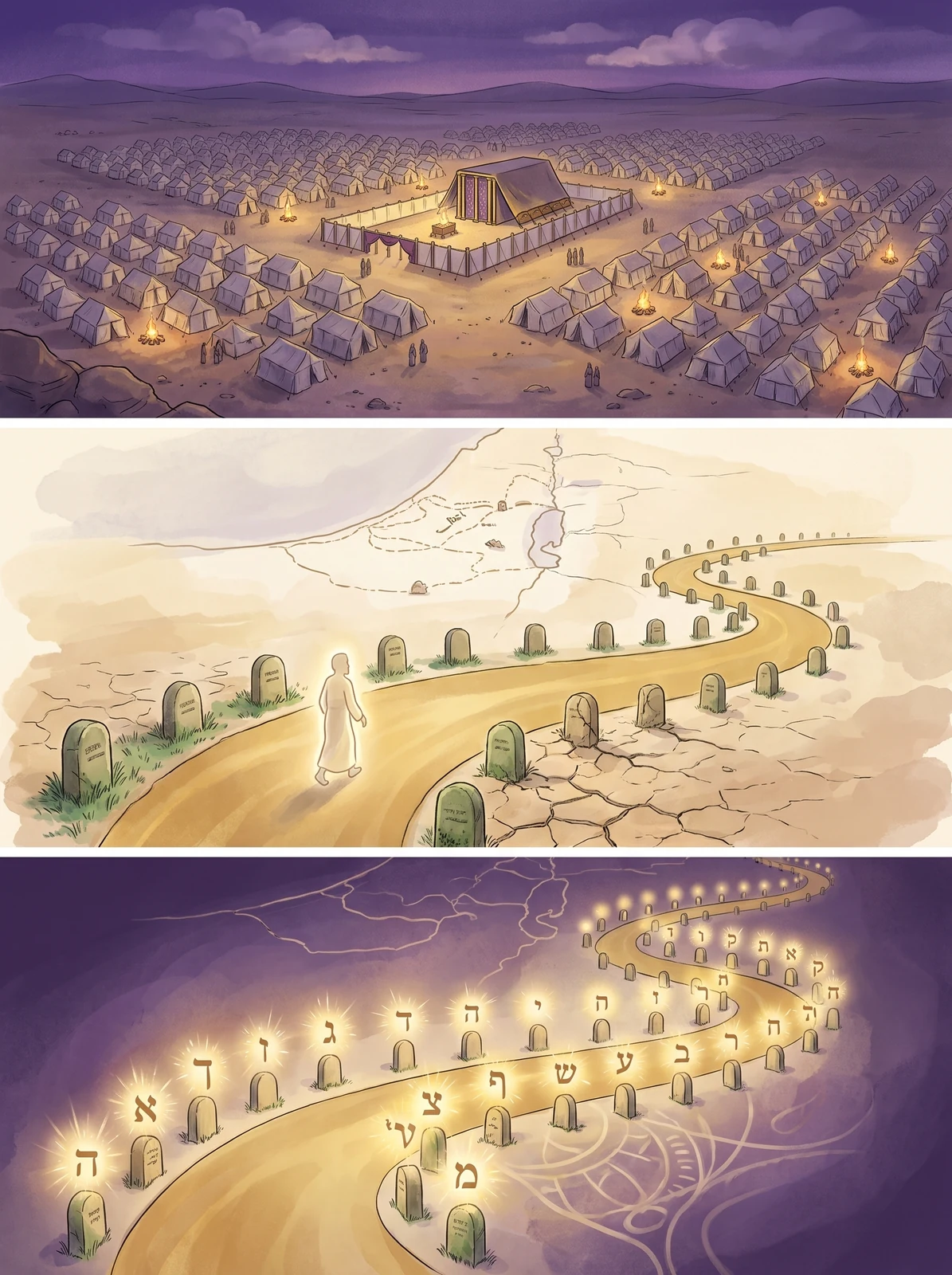
The 42 stops of the Israelites sit exactly between the exodus from Egypt and the entry into the land of Israel. Michael Berg reads that placement as a map: Egypt is Galut, all of the darkness; the land of Israel is elevation, the removal of pain, suffering and death.
And what lies between the two? The 42 Letters. The only way from darkness to Light, he teaches, runs through the Ana BeKo'ach.
Masei closes the Fourth Book and, as the kabbalists read it, closes the Torah. The Fifth Book, the Mishneh Torah, serves another purpose. Which means: the final words of Moshe's Torah are here.
And Michael Berg begins from a simple intuition: when a great teacher knows the hour has come to leave this world, what he gives at the end is what he held back his whole life. That is what Rav Shimon bar Yochai did in the Idra Zuta, when he said there were things he had withheld all those years and that now he had to give.
Read literally, the portion lists the 42 stops of the Israelites on the journey. But the Torah does not spend an extra letter. If the point were to record historical facts, anyone could write the list.
The Ramban (Rav Moshe ben Nachman), who almost always reveals the secret after the literal explanation, does something strange here: he quotes Rashi, he quotes the Rambam (Maimonides), and then he says that the secret of this portion has not been revealed to us. In the Talmud, in the passage on the 42 Letter Name, Rashi writes it again: "this Name, we do not know it."
Michael Berg is direct: the later commentators understand that they were concealing it. They knew the secret, and they knew the world could not yet receive it. The 42 stops are the 42 Letters of the Ana BeKo'ach.
The Talmud tells us that the true power of the Priestly Blessing was not in the words said aloud. The raised hands were a veil. A few, the tzenuim, would whisper the Letters while everyone else recited the blessing.
And the criteria for receiving the 42 Letter Name were severe: someone with no ego, completely humble, who never grows angry, who does not care if people mock him.
As Rav Berg always reminded us: yodea, to know, never meant having the information. All of us have the letters printed. Almost none of us have the connection.
Here is the most practical correction in the whole class. Most prayers ask: give me healing, give me sustenance. The Ana BeKo'ach asks for nothing.
It is the most powerful way to call the Light of the Creator. That is why, at the end of the seven verses, we say silently Baruch Shem kevod malchuto. Because we have just said a Name, not a prayer. And baruch does not mean "blessed": it means filled with Light and with blessings.
"I ask the Light to fix this for me."
"I call the totality of the Light of the Creator into this world."
Seven verses, six letters in each. The Maharal explains: six represents the entirety of the physical world (north, south, east, west, up, down). Seven represents the Sheva Reki'im, the seven heavens, the Upper World.
Michael Berg then says the sentence that holds up the entire class: our greatest problem, individually and collectively, is that this world is disconnected from its source.
The work of the Ana BeKo'ach is exactly this: seven times, taking the six corners of the physical world and reconnecting them to the Upper World. All healing, all removal of chaos, follows from that.
Moshe's final act of teaching is strange: he speaks of six cities of refuge and another 42, a law that would only be used many years after his death. Why spend your last words on that?
Because it is not about cities. A person who takes another's life, even without intending to, represents the maximum degree of disconnection from the Light of the Creator. It is a code. And Moshe is saying: even for the most disconnected human being, there is a way back, and its number is 42.
The portion begins with the 42 stops. It ends with the 42 cities of refuge. And between the two, Moshe brings into our world access to the 42 Letters.
The cities of refuge only served the person who was running. Whoever stayed home was not saved by them. And this is where Michael Berg gives us the real conditions for using the Name.
First: the opening verse already says everything. Ana BeKo'ach, Gedulat Yeminecha, Tatir Tzerura. "Please, with the strength of Your greatness, set free those who are bound." The bound ones are us. And how do you know whether you are disconnected? If you are not happy every second of the day, you are disconnected, to the exact degree that you are not.
Second: you have to be on the move. It is not enough to say the letters comfortably, between one appointment and the next, hoping they "might help".
The Gaon of Vilna reveals that the numerical value of the first and the last verse of the Ana BeKo'ach is the same as the word tola'at, worm. And the Midrash quotes Yeshayahu (Isaiah): "fear not, worm of Yaakov."
Why compare those who connect to the Light of the Creator to a worm? Because the worm looks small and fragile, yet, given time, it brings down the strongest trees. And because the worm only moves forward through its mouth. If it is not eating, it does not move.
It is a picture of us. Our only strength, our only way forward, is the mouth: the Ana BeKo'ach. That is why Moshe saved it for the end. It is not one tool among others. It is the tool.
He closes the class with an image worth carrying: after a full day of skiing, the mountain is covered in grooves and marks. Then the snowstorm comes and everything is smooth again. That is what this Shabbat offers: erasing every old groove, every old understanding we have of the Ana BeKo'ach, and starting from zero.
If I truly believed the Ana BeKo'ach were the only way back, with what urgency would I say it today?
Original lecture: Michael Berg, Matot-Masei · Accessing the 42 Letter Name (Shabbat, July 10, 2021) · Kabbalah Centre. This page is a synthesis and adaptation by Thiago Moshe, not a transcript. The highlighted lines are paraphrases of the teacher, not literal quotations.
Textual sources cited in the lecture itself: the portion of Masei; the commentary of the Ramban (Rav Moshe ben Nachman) and of Rashi; the Talmud (Kidushin, on the 42 Letter Name and the Priestly Blessing); the Maharal (six and seven); the Gaon of Vilna and the Midrash on tola'at Yaakov (Yeshayahu / Isaiah).
Comments
Share what this study awakened in you. We are here to listen.
Loading…